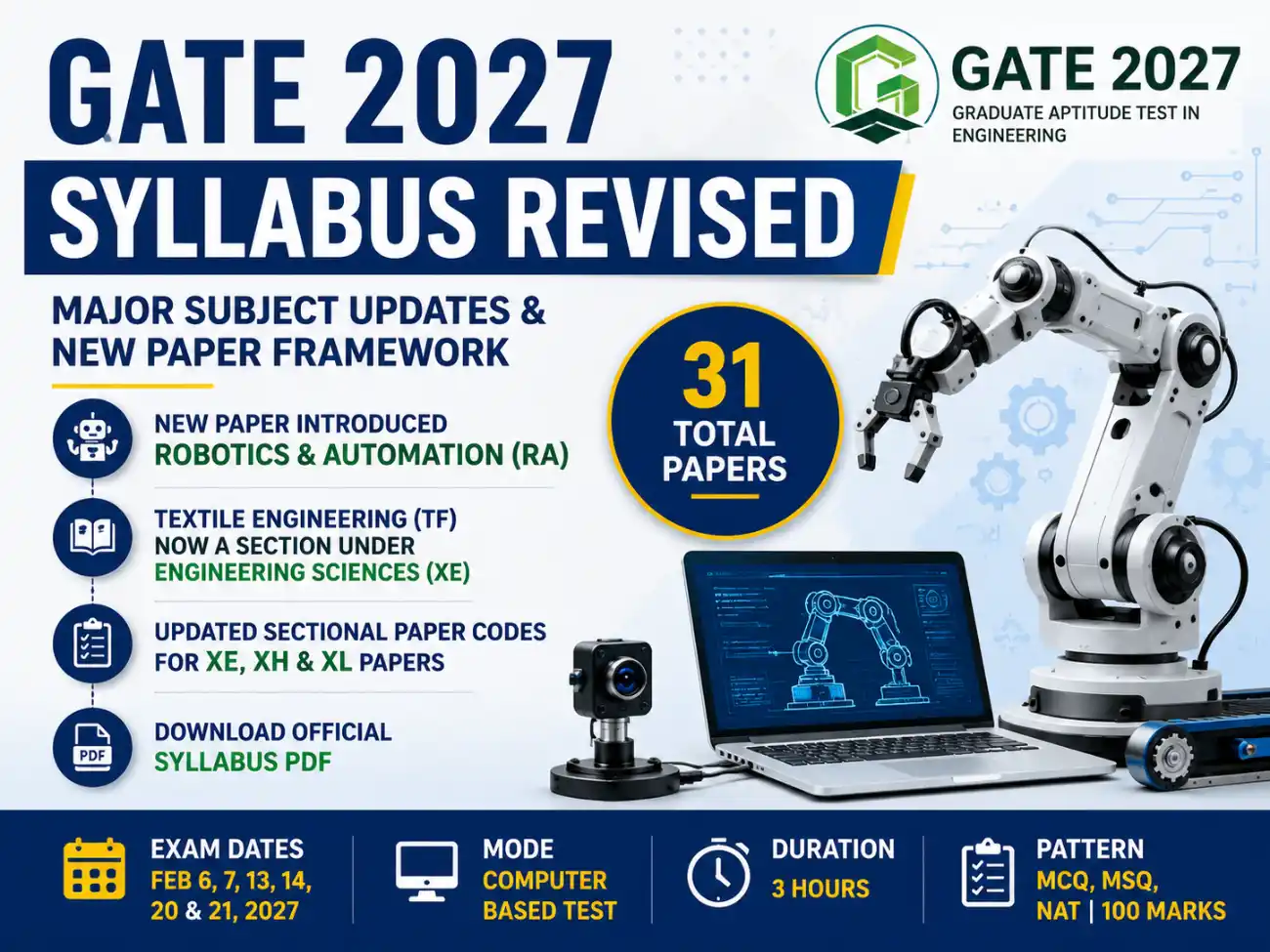
GATE 2027 Syllabus Revised has officially been announced by the Indian Institute of Technology (IIT) Madras, the organizing institute for the Graduate Aptitude Test in Engineering (GATE) 2027. Along with the Information Brochure, IIT Madras has published the latest syllabus, introducing important changes that candidates should review before starting their preparation.
The biggest update this year is the introduction of the Robotics & Automation (RA) paper as a separate subject. In addition, IIT Madras has revised the syllabus of several existing papers, reorganized sectional papers, and updated paper combinations to better reflect current academic and industry requirements.
This guide explains all major updates in the GATE 2027 syllabus, exam pattern, new paper framework, subject revisions, and how candidates can download the official syllabus PDF.
GATE 2027 Exam Highlights
Here are the key highlights of the latest GATE 2027 examination announced by IIT Madras.
| Particular | Details |
|---|---|
| Exam Name | Graduate Aptitude Test in Engineering (GATE) 2027 |
| Organizing Institute | IIT Madras |
| Examination Mode | Computer-Based Test (CBT) |
| Duration | 3 Hours |
| Total Marks | 100 |
| Question Types | MCQ, MSQ, NAT |
| Total Papers | 31 |
| New Paper Added | Robotics & Automation (RA) |
| Exam Dates | February 6, 7, 13, 14, 20 and 21, 2027 |
The overall examination pattern remains unchanged, allowing candidates to continue preparing using the familiar CBT format.
What is the GATE 2027 Syllabus?
The GATE 2027 syllabus defines the complete list of subjects, chapters, and topics from which questions will be asked in the examination. Every paper has its own syllabus, enabling candidates to prepare according to their selected engineering or science discipline.
For most engineering papers, the syllabus consists of three major sections:
- General Aptitude (GA)
- Engineering Mathematics (where applicable)
- Core Subject Topics
General Aptitude is common across all papers, while Engineering Mathematics and technical subjects vary depending on the paper selected by the candidate.
Studying the official syllabus before beginning preparation helps candidates avoid unnecessary topics and focus only on the prescribed curriculum.
Major GATE 2027 Syllabus Update: Robotics & Automation (RA) Added as the 31st Paper
The most significant change in GATE 2027 is the introduction of Robotics & Automation (RA) as a standalone examination paper.
Robotics has become one of the fastest-growing engineering fields due to rapid developments in industrial automation, autonomous systems, artificial intelligence, manufacturing, healthcare, and smart robotics. By introducing a dedicated paper, IIT Madras has created a specialized pathway for students interested in these interdisciplinary technologies.
The new RA paper combines concepts from multiple engineering disciplines, including:
- Mechanical Engineering
- Electrical Engineering
- Electronics Engineering
- Computer Science
- Control Systems
- Artificial Intelligence
This addition increases the total number of GATE papers from 30 to 31.
mportant Topics Expected in Robotics & Automation (RA)
According to the official syllabus, the Robotics & Automation paper includes concepts related to robotic system design, sensing, control, and intelligent automation.
Major subject areas include:
- Robot Kinematics
- Robot Dynamics
- Actuators
- Sensors
- Feedback Control Systems
- Signal Conditioning
- Embedded Systems
- Robot Programming
- Real-Time Control
- Machine Vision
- Image Processing
- Artificial Intelligence Applications
- Industrial Automation Fundamentals
The paper is designed to evaluate both theoretical understanding and practical engineering concepts.
Textile Engineering (TF) Paper Moved Under Engineering Sciences (XE)
Another major structural revision announced for GATE 2027 concerns the Textile Engineering and Fibre Science (TF) paper.
Instead of continuing as an independent paper, Textile Engineering has now been incorporated into the Engineering Sciences (XE) paper as one of its sections.
This restructuring changes how candidates interested in Textile Engineering will appear for the examination. Applicants should carefully read the updated paper structure before selecting their examination paper during registration.
Changes in XE, XH and XL Sectional Papers
IIT Madras has also revised the sectional framework for the following multidisciplinary papers:
- Engineering Sciences (XE)
- Humanities & Social Sciences (XH)
- Life Sciences (XL)
According to the official notification, sectional paper codes and combinations have been updated. Candidates applying for these papers should carefully verify the latest section options and paper codes mentioned in the official Information Brochure before completing the application process.
Has the GATE 2027 Exam Pattern Changed?
Although several syllabus updates have been introduced, the overall examination pattern remains the same.
Candidates can expect:
- Computer-Based Test (CBT)
- Three-hour duration
- Total of 100 marks
- Multiple Choice Questions (MCQ)
- Multiple Select Questions (MSQ)
- Numerical Answer Type (NAT) questions
Since the exam pattern has not changed, aspirants can continue following existing preparation strategies while updating their study material according to the revised syllabus.
How to Download the GATE 2027 Revised Syllabus PDF
Candidates can download the official syllabus directly from the GATE 2027 portal by following these steps:
Step 1
Visit the official GATE 2027 website maintained by IIT Madras.
Step 2
Open the “Papers and Syllabus” section available on the homepage.
Step 3
Choose your desired GATE paper from the complete list of available subjects.
Step 4
Open the syllabus PDF for your selected paper.
Step 5
Download the PDF and keep a printed copy for regular preparation and revision.
Using the official syllabus ensures that candidates study only the topics prescribed for the examination.
How Many Papers Are Available in GATE 2027?
With the addition of Robotics & Automation, GATE 2027 now offers 31 examination papers covering a broad range of disciplines.
These papers include engineering, technology, architecture, sciences, humanities, management-related subjects, and interdisciplinary fields.
Each paper generally contains:
- General Aptitude
- Engineering Mathematics (where applicable)
- Subject-specific technical topics
Candidates should choose the paper that best aligns with their educational qualifications and future career plans.
Why These Syllabus Updates Matter
The revised syllabus reflects the growing importance of emerging technologies and interdisciplinary engineering education.
Some of the benefits of the latest updates include:
- Better alignment with current industry requirements
- Inclusion of advanced technologies like robotics and automation
- More relevant curriculum for postgraduate admissions
- Improved preparation for PSU recruitment examinations
- Updated learning outcomes for engineering graduates
Candidates who begin their preparation using the revised syllabus will have a clearer understanding of the latest examination expectations.
Preparation Tips for GATE 2027 Aspirants
Since the syllabus has been updated, candidates should revise their preparation strategy accordingly.
A few practical recommendations include:
- Download the latest official syllabus before starting preparation.
- Compare the revised syllabus with previous years to identify newly added topics.
- Follow standard textbooks recommended for your discipline.
- Practice previous years’ GATE questions wherever the syllabus overlaps.
- Allocate additional preparation time to newly introduced concepts if applying for the Robotics & Automation paper.
- Regularly monitor official notifications for any further updates regarding paper combinations or eligibility.
Conclusion
The GATE 2027 Syllabus Revised by IIT Madras introduces meaningful changes while keeping the examination pattern unchanged. The addition of the Robotics & Automation (RA) paper expands opportunities for students interested in modern automation technologies, while the restructuring of the Textile Engineering paper and updates to XE, XH, and XL improve the overall organization of multidisciplinary papers.
Candidates should rely only on the official syllabus while preparing for the examination and ensure they understand the revised paper structure before submitting their application. Starting preparation with the latest syllabus will help build a focused study plan and reduce the chances of missing newly introduced topics.
Frequently Asked Questions (FAQs)
What is the biggest change in the GATE 2027 syllabus?
The biggest update is the introduction of Robotics & Automation (RA) as the 31st standalone GATE paper.
Has the Textile Engineering (TF) paper been discontinued?
The TF paper is no longer offered as an independent paper. It has been incorporated as a section under Engineering Sciences (XE).
Has the GATE 2027 exam pattern changed?
No. The examination will continue as a 3-hour Computer-Based Test consisting of MCQ, MSQ, and NAT questions carrying a total of 100 marks.
Where can candidates download the official GATE 2027 syllabus?
The latest syllabus for every paper is available on the official GATE 2027 website managed by IIT Madras under the “Papers and Syllabus” section.
How many papers are available in GATE 2027?
GATE 2027 now offers 31 papers, including the newly introduced Robotics & Automation (RA) paper.
