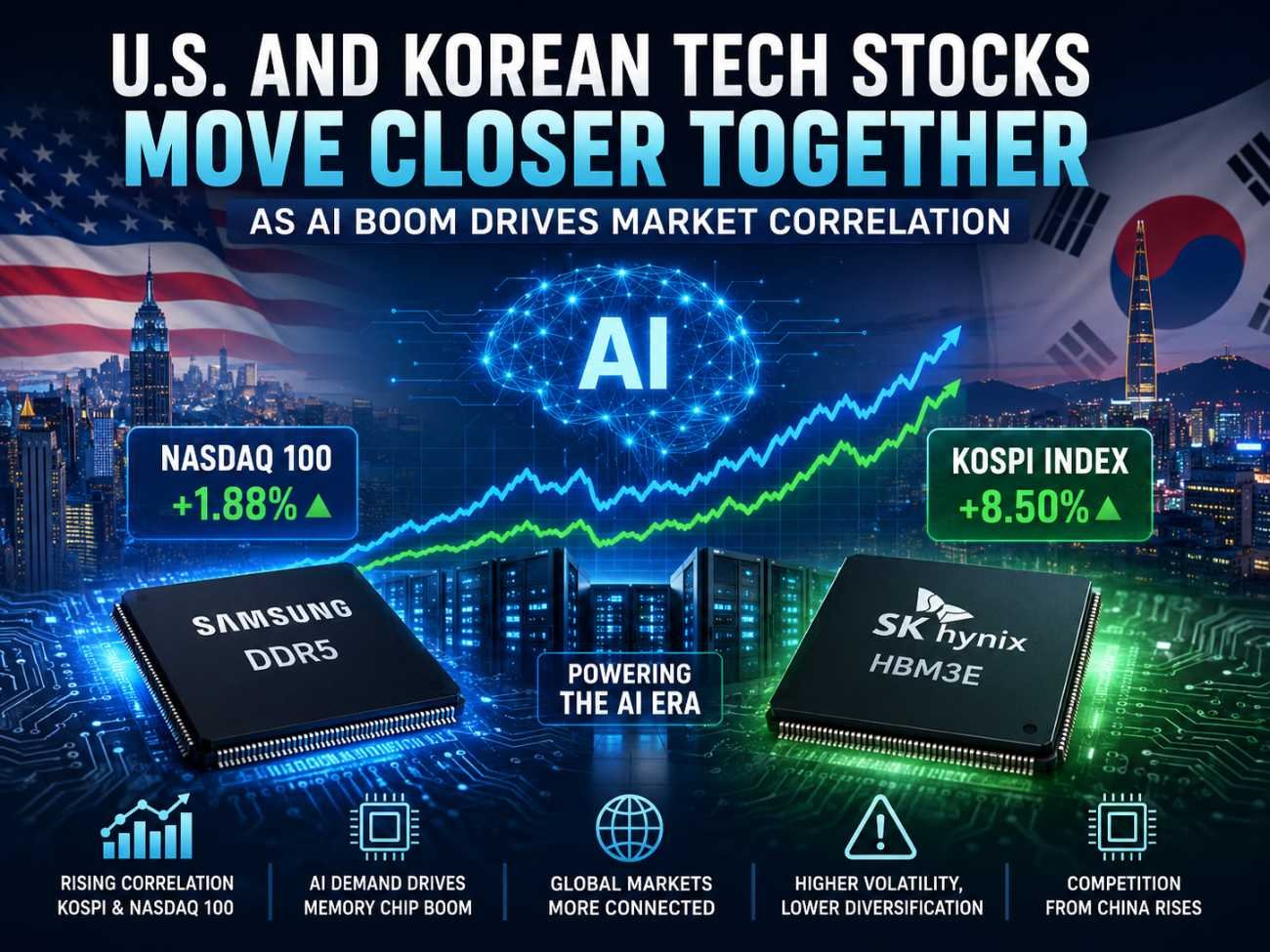
The artificial intelligence (AI) boom is changing how global stock markets behave, with U.S. and South Korean technology stocks now moving more closely than they have in years. Analysts say growing demand for AI infrastructure has strengthened the relationship between Wall Street’s biggest technology companies and South Korea’s leading memory chip manufacturers.
The trend highlights how AI spending is reshaping global investment patterns while also reducing the diversification benefits investors traditionally enjoyed by investing across different countries.
AI Spending Is Connecting U.S. and Korean Markets
Recent market data shows the relationship between South Korea’s Kospi Index and the Nasdaq-100 has reached its strongest level since 2021. The increasing correlation reflects the growing importance of AI-related semiconductor companies in both markets.
South Korea’s stock market is now heavily influenced by semiconductor giants Samsung Electronics and SK Hynix, which together represent more than half of the Kospi index. These companies manufacture advanced memory chips that power AI servers and large-scale data centers used by major U.S. technology companies.
As global AI investment continues to accelerate, demand for these components has become a major driver of stock performance on both sides of the Pacific.
Memory Chip Makers Play a Critical Role
AI applications require enormous computing power, and that depends heavily on advanced memory technologies such as DRAM and High-Bandwidth Memory (HBM).
Industry analysts note that data centers now account for more than half of global DRAM demand, a significant increase from the previous year. As AI companies continue expanding their infrastructure, memory suppliers have become some of the biggest beneficiaries.
Because Samsung and SK Hynix are among the world’s largest memory manufacturers, their financial performance increasingly reflects the overall health of the AI industry.
Korean Stocks Often React First
One interesting market development is that South Korean technology stocks frequently respond to overnight AI-related news before U.S. markets open.
Since Korean markets begin trading earlier due to time-zone differences, investors often view Samsung and SK Hynix as early indicators of market sentiment surrounding AI demand.
When important AI developments occur after Wall Street closes, movements in Korean semiconductor stocks may provide clues about how U.S. investors could react when American markets reopen.
Likewise, when major AI announcements occur during U.S. trading hours, Nasdaq performance often influences the following trading session in South Korea.
AI Theme Is Becoming the Common Driver
Market experts believe that neither the U.S. nor South Korea consistently leads the other. Instead, both markets are increasingly responding to the same underlying factor—investor confidence in AI hardware spending.
As cloud providers continue investing billions of dollars into AI infrastructure, semiconductor manufacturers on both continents benefit from higher demand for advanced chips and memory products.
This shared exposure explains why the two markets have become increasingly synchronized.
Diversification Benefits Are Shrinking
While stronger market alignment reflects the growth of AI, it also creates new challenges for investors.
Traditionally, investors diversified portfolios by holding stocks from different countries. However, when multiple markets are driven by the same industry, geographical diversification becomes less effective.
With Samsung and SK Hynix dominating South Korea’s benchmark index, any slowdown in AI infrastructure spending or reductions in data-center investment could have an outsized impact on Korean equities.
Analysts also point out that Korean semiconductor stocks tend to experience greater price volatility than many of their U.S. counterparts, making market swings more pronounced during periods of uncertainty.
Factors That Could Create Future Differences
Although AI demand currently supports both U.S. and Korean chipmakers, analysts believe their performance may eventually diverge.
Several factors could influence future market differences, including:
- Company-specific investment strategies.
- Differences in product portfolios.
- Government incentives supporting domestic semiconductor production.
- Capital expenditure decisions.
- Competitive positioning in advanced memory technologies.
These variables may cause Samsung, SK Hynix, and U.S. memory producers to perform differently over the long term, even if they currently benefit from the same AI investment cycle.
China Adds Another Competitive Challenge
Another emerging factor is China’s growing presence in the memory semiconductor industry.
Chinese chip manufacturers continue investing heavily to narrow the technology gap with established global leaders. Although they still trail industry giants in advanced manufacturing capabilities, analysts say their progress has been faster than many investors expected.
Continued expansion by Chinese companies could increase competition in the global memory market and influence pricing, profitability, and future investment trends across the semiconductor sector.
What Investors Should Watch
Going forward, investors will closely monitor several indicators that could shape both U.S. and South Korean technology stocks:
- AI infrastructure spending by major cloud companies.
- Quarterly earnings from Samsung Electronics and SK Hynix.
- Global demand for DRAM and High-Bandwidth Memory.
- Semiconductor pricing trends.
- Government chip policies in the U.S., South Korea, and China.
These factors will likely determine whether the close relationship between the two markets continues or begins to weaken.
Conclusion
The rapid expansion of artificial intelligence has created a stronger connection between U.S. technology stocks and South Korea’s semiconductor industry. As AI data centers consume increasing amounts of advanced memory chips, companies like Samsung Electronics and SK Hynix have become central to the global AI supply chain.
While this trend offers investors valuable insight into AI market sentiment, it also reduces the diversification advantages of investing across different regions. Future developments in semiconductor competition, government policy, and AI spending will determine whether the current market alignment remains strong or begins to separate in the years ahead.
