
If you’re researching the University of Edinburgh acceptance rate, you’re probably trying to understand how competitive admission is and whether you have a realistic chance of receiving an offer.
The University of Edinburgh is one of the United Kingdom’s most respected universities. Every year, it receives tens of thousands of applications from students across the UK and around the world. Because of its global reputation, admission can be highly competitive, especially for popular programs such as Medicine, Law, Computer Science, Business, and Psychology.
In this guide, you’ll learn what the University of Edinburgh acceptance rate means, why it varies by course, what international students should know, and how to build a stronger application.
What Is the University of Edinburgh Acceptance Rate?
There is no single official University of Edinburgh acceptance rate that applies to every applicant or every degree program.
Instead, the university publishes admissions statistics by subject (selection area) and fee status, including the number of applications received, offers made, offer rates, and acceptances. This approach gives applicants a more accurate picture of competition for their chosen course rather than relying on one overall percentage.
Many websites publish an overall acceptance rate, but those figures are usually estimates and may not reflect current admissions data. For this reason, applicants should rely on the university’s official admissions statistics whenever possible.
Read Also: 10+ Best High Acceptance Rates Colleges in 2026
University of Edinburgh Acceptance Rate for International Students

Many prospective applicants specifically search for the University of Edinburgh acceptance rate for international students because they want to understand how competitive admission is for overseas candidates.
The University of Edinburgh does not publish one official acceptance rate for all international students. Instead, it provides admissions statistics based on Overseas fee status and selection areas (subject groups). This means your chances of receiving an offer depend primarily on the course you choose rather than a single university-wide percentage.
Some degree programs receive significantly more international applications than others. Courses such as Medicine, Law, Business, Artificial Intelligence, Computer Science, and Economics often attract a large number of highly qualified applicants from around the world, making them especially competitive. On the other hand, some subjects may have higher offer rates depending on the number of applications and available places in a particular admission cycle.
The university reviews international applicants within the International (Overseas) fee status category rather than comparing them directly with applicants in other fee-status groups. This helps ensure that applicants are assessed fairly within the same admissions pool.
Instead of relying on unofficial websites that publish a single percentage, international students should review the University’s official admissions statistics for their intended subject. These statistics include the number of applications received, offers made, offer rates, and accepted students, giving a much clearer picture of competition for each program.
How International Students Can Improve Their Chances
International applicants can strengthen their application by:
- Exceeding the published academic entry requirements.
- Demonstrating strong English language proficiency through an accepted qualification if required.
- Writing a thoughtful and course-focused personal statement.
- Applying to a program that matches their academic background and interests.
- Carefully checking all course-specific requirements before submitting the application.
While admission remains competitive, a well-prepared application that meets or exceeds the university’s expectations has a stronger chance of receiving an offer.
Why the University of Edinburgh Is So Competitive
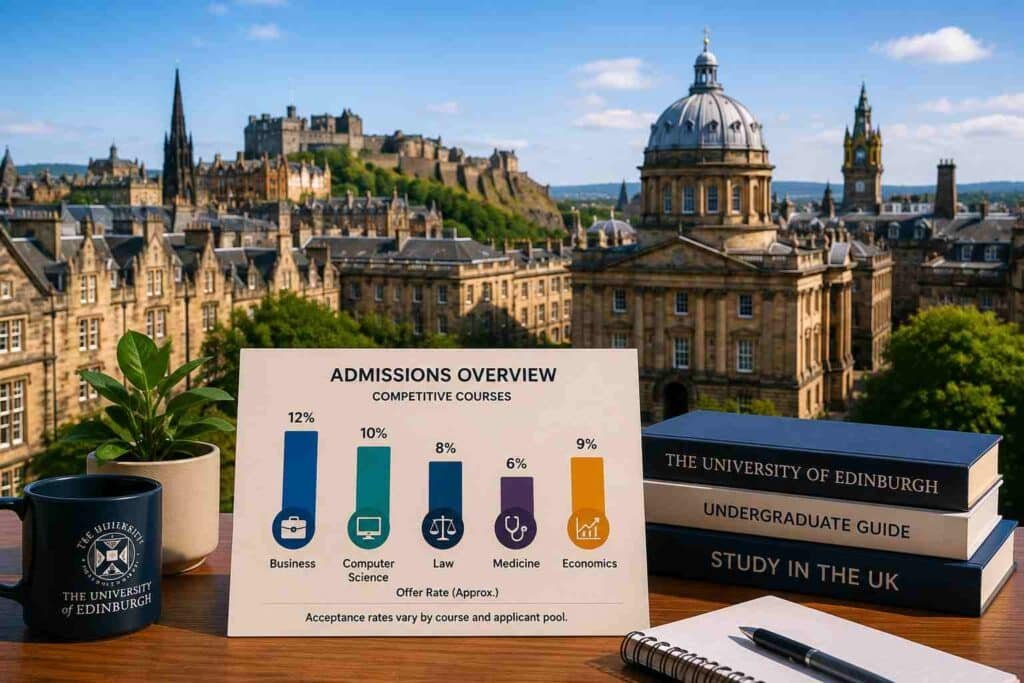
The University of Edinburgh consistently ranks among the leading universities in the UK and enjoys a strong international reputation for teaching and research.
Several factors contribute to its competitive admissions process:
- Thousands of applications are submitted every year.
- Many degree programs have limited places.
- Applicants come from more than 150 countries.
- Highly ranked programs attract exceptionally strong candidates.
- Academic standards are high across most faculties.
Competition can vary significantly depending on the subject you choose.
University of Edinburgh Acceptance Rate for International Students
Many applicants search for the University of Edinburgh acceptance rate for international students.
The university does not publish one overall acceptance rate specifically for international students. Instead, it releases admissions statistics for Overseas fee status applicants by selection area. This means an international applicant’s chances depend largely on the course they apply for rather than on a university-wide percentage.
Some programs receive far more international applications than available places, making them much more competitive than others.
Students should review the admissions statistics for their intended subject instead of relying on general figures found online.
How Admissions Statistics Are Reported
One important point many applicants misunderstand is the difference between an offer rate and an acceptance rate.
The University of Edinburgh publishes:
- Total applications
- Number of offers made
- Offer rate
- Number of accepted students
An offer does not automatically become an enrolled student because applicants may receive offers from multiple universities before making their final choice.
Understanding this distinction helps applicants interpret admissions data more accurately.
Which Courses Are the Most Competitive?
Competition varies considerably across academic disciplines.
Programs that are generally among the most competitive include:
- Medicine
- Veterinary Medicine
- Law
- Computer Science
- Artificial Intelligence
- Business
- Economics
- Psychology
- Architecture
These programs often receive many more qualified applicants than available places.
Meanwhile, other subjects may have higher offer rates depending on annual demand.
Admission Requirements
Meeting the minimum entry requirements does not guarantee admission.
The admissions team evaluates each application carefully based on academic preparation and the competitiveness of the applicant pool.
Typical requirements include:
Strong Academic Performance
Applicants are expected to achieve excellent grades in qualifications such as:
- A Levels
- International Baccalaureate (IB)
- Advanced Placement (AP)
- National education systems accepted by the university
Each program publishes its own required grades.
English Language Proficiency
International students whose first language is not English usually need to demonstrate English proficiency through an approved qualification such as IELTS, TOEFL, or another accepted English language test unless they qualify for an exemption. Specific score requirements vary by program.
Personal Statement
For undergraduate applicants applying through UCAS, the personal statement provides an opportunity to explain:
- Academic interests
- Motivation for the chosen subject
- Relevant achievements
- Skills and experiences
A thoughtful and well-structured statement can strengthen an application.
Academic References
Most undergraduate applications also require an academic reference from a teacher or school counselor.
Strong references should describe academic ability, commitment, and readiness for university-level study.
Factors That Influence Your Chances
Admission decisions are based on more than grades alone.
Depending on the program, admissions tutors may consider:
- Academic achievements
- Subject preparation
- Predicted grades
- Personal statement
- Academic reference
- Course competition
- Available places
Some professional programs may also require additional assessments or interviews.
Tips to Improve Your Chances of Admission
Although admission is competitive, students can strengthen their applications with careful preparation.
Choose subjects in high school that match your intended university course. Strong academic performance in relevant subjects demonstrates readiness for university study.
Take time to write a personal statement that focuses on your genuine academic interest instead of repeating general career goals.
Participate in activities that support your chosen field, such as research projects, competitions, volunteering, or subject-related clubs.
Submit your application before the deadline and carefully review every document for accuracy.
Is the University of Edinburgh Worth It?
Many students choose Edinburgh because of its academic reputation, research opportunities, international community, and historic campus.
The university offers:
- Globally recognized degrees
- Extensive research facilities
- International student support
- Study abroad opportunities
- Wide range of undergraduate and postgraduate programs
Graduates are employed across industries including technology, healthcare, finance, government, education, and research.
Common Mistakes Applicants Should Avoid
Many strong applicants weaken their chances through avoidable errors.
These include applying without checking course-specific requirements, submitting a generic personal statement, overlooking English language requirements, or assuming that meeting minimum grades guarantees admission. Reading the official admissions guidance carefully before applying can prevent these problems.
Understanding the University of Edinburgh acceptance rate requires looking beyond a single percentage. The university evaluates applicants by course and fee status, so admission chances can vary widely depending on the program you choose.
Rather than focusing only on estimated acceptance rates, review the official admissions statistics for your intended subject, meet or exceed the academic requirements, prepare a strong personal statement, and apply with a well-rounded application. Careful preparation gives you the best opportunity to compete for a place at one of the UK’s leading universities.
Frequently Asked Questions
What is the University of Edinburgh acceptance rate?
The university does not publish one overall acceptance rate. Instead, it releases admissions statistics by subject area and fee status, including applications, offers, offer rates, and accepted students.
What is the University of Edinburgh acceptance rate for international students?
There is no single official acceptance rate for international students. Admission competitiveness depends on the specific course and the Overseas fee status statistics for that selection area.
Is the University of Edinburgh difficult to get into?
Yes. Many programs are highly competitive because the university receives a large number of applications from qualified students worldwide.
Does meeting the minimum entry requirements guarantee admission?
No. Meeting the published requirements makes you eligible for consideration, but admission depends on the strength of your application and competition within your chosen program.
Where can I check official admissions statistics?
The University of Edinburgh publishes annual admissions statistics by selection area, including applications, offers, offer rates, and acceptances for different fee-status categories.
